· AI · 4 min read
Vibe Coding vs. Good Coding. Is AI Building a House of Cards?
As "vibe coding" surges, experts and tech leaders warn that relying solely on AI's "vibes" to build software could lead to systemic collapses. While AI applicability is high in tech, the shift from logic-driven engineering to natural language prompting poses significant risks for long-term stability.
The New Frontier of Development
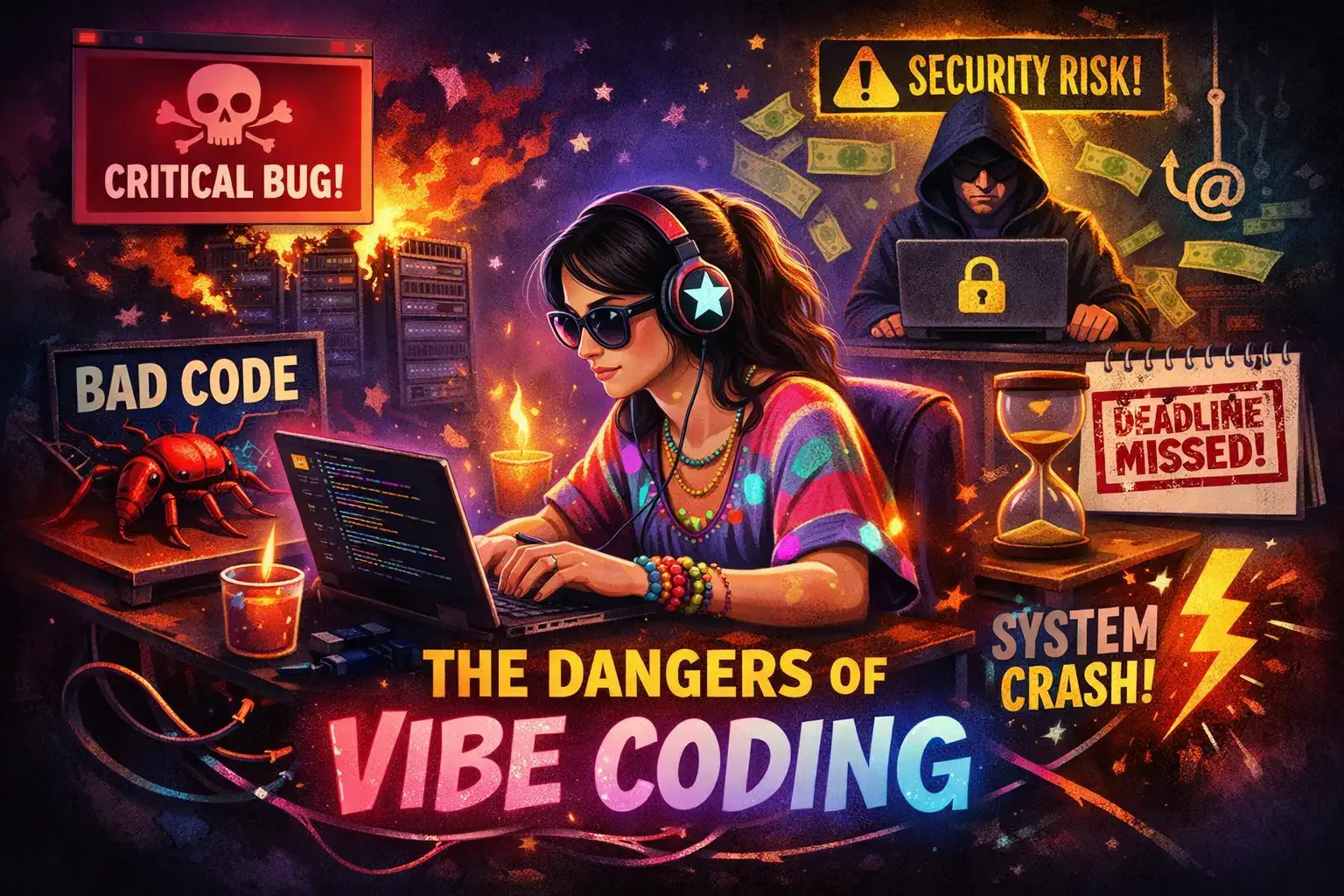
In the tech world of 2025, a new term has taken over developer Twitter and GitHub repos alike: Vibe Coding.
It’s the ultimate dream of the generative AI era. Instead of wrestling with syntax or debugging logic for hours, you simply describe a “vibe”—a general idea of what you want—and let an AI agent build it from the ground up. It’s fast, it’s magical, and according to Michael Truell, the CEO of Cursor¹, it might be the most dangerous habit a developer can develop.
A Warning from the Front Lines¹
Speaking recently at the Fortune Brainstorm AI conference, Truell—whose company is arguably the leader in AI-native coding—issued a sobering warning: If you build on vibes alone, your foundations will eventually crumble.
What Exactly is Vibe Coding?
Vibe coding is the practice of treating AI as an “end-to-end” black box. You give it a prompt like “Build me a dashboard that looks like Stripe and connects to my database,” and then—this is the crucial part—you don’t look at the code.
You check if it runs. You check if the “vibes” are right. If it looks good and the buttons click, you move on.
The Construction Analogy: Building on Sand
Building software through “vibe coding”—relying purely on AI prompts without technical oversight—is often compared to commissioning a house with your eyes closed.
While the AI is remarkably efficient at framing a single room or a simple prototype, the structural integrity remains a mystery. You aren’t inspecting the foundation, checking the plumbing, or verifying the electrical wiring; you’re simply trusting the “vibe” of the finished product.
The danger isn’t immediate. The first floor usually looks and functions well enough. However, the system faces a reckoning when you attempt to scale. Without a solid, inspected foundation, the entire structure risks a catastrophic collapse the moment you try to add a second, third, or fourth story.
When you build on top of unexamined, “shaky” AI code:
Technical debt compounds exponentially: Small logic errors in the “foundation” make every future feature harder to implement.
Security becomes a ghost: If you didn’t check the “wiring,” you don’t know where the fire hazards (vulnerabilities) are hidden.
The “Crumble” Point: Eventually, the system becomes so complex and the underlying logic so fragmented that the AI can no longer “fix” it, and the human developer—who hasn’t been reading the code—has no idea how to save it.
The Paradox: A Warning from the King of AI Coding It might seem ironic that the CEO of Cursor—the very tool people use to generate massive amounts of code—is the one telling us to slow down. But Truell’s perspective is rooted in professional engineering rigor.
Beyond the Drudge Work
Modern software development is shifting toward a model where AI takes over the “drudge work”—the repetitive, boilerplate tasks—allowing developers to elevate their role. In this framework, the human remains the master architect, maintaining total oversight and obsessing over the fine-grained implementation details that define quality.
The New Developer Paradigm
The shift toward an AI-augmented workflow represents a fundamental evolution in the software engineering craft. By delegating the mundane aspects of programming to intelligent agents, you can offload the mental tax of managing verbose syntax, generating repetitive unit tests, and executing routine refactoring tasks. This transition effectively removes the friction of boilerplate development, allowing for a much faster iteration cycle where the focus moves away from the mechanics of the keyboard and toward the elegance of the solution.
In this new landscape, the role of the developer transforms into that of the architect’s oversight. You are no longer just a builder laying bricks but a visionary who must maintain a holistic view of the entire system architecture to ensure that every modular component integrates seamlessly within the high-level logic. This requires a deeper understanding of system design, as the ability to direct an AI effectively depends entirely on your capacity to define clear boundaries, scalable structures, and robust data flows.
Finally, this paradigm demands an intense obsession with detail that acts as a critical failsafe against automated errors. While the AI generates the initial draft or implementation, the developer remains the ultimate arbiter of quality who must scrutinize every line of output for subtle logical flaws or hidden vulnerabilities. By fine-tuning performance bottlenecks and hardening security protocols, you ensure that the final product transcends the “good enough” output of a machine and reaches the exacting standards of professional-grade software.
Vibes are fine for a weekend side project or a quick mockup. But for the software that runs our banks, hospitals, and infrastructure? Vibes aren’t enough.
References:
- Lamm, S. (2024, December 25). The CEO of the world’s most popular AI coding assistant has a warning about ‘vibe coding.’ Fortune.